
Optimizing Your Google Business Profiles for Multi-Location Clinics
Ready to grow your business?
Why does your Google Business Profile matter for multi-location clinic SEO?
The direct answer? Because your Google Business Profile (GBP) is often the first “landing page” a patient sees, before your website, before your ads, and sometimes before they even know your brand name.
For multi-location clinics, GBP gets even more strategic:
It’s how you win the map pack (those top local results) for each service area.
It’s how you reduce friction for high-intent searches like “urgent care near me,” “PT clinic in [city],” or “primary care same-day appointment.”
It’s how you build trust at scale, especially through patient reviews (and how you respond to them without triggering patient reviews HIPAA issues).
If you’re a founder trying to grow responsibly, treat GBP like a distributed storefront: one brand, many entrances, and every entrance needs to be accurate, compelling, and compliant.
“GBP optimization” vs. “clinic SEO”
The short answer? GBP optimization is a subset of clinic SEO, not a replacement for it.
Google Business Profile optimization = improving each location’s visibility and conversion inside Google Maps + local search results.
Clinic SEO = the broader system: location pages, service pages, technical SEO, content strategy, local citations, review strategy, and authority building.
If you want the bigger picture on why SEO still matters (even with AI changing search behavior), you’ll like our take here: Does medical SEO strategy still matter in 2026?
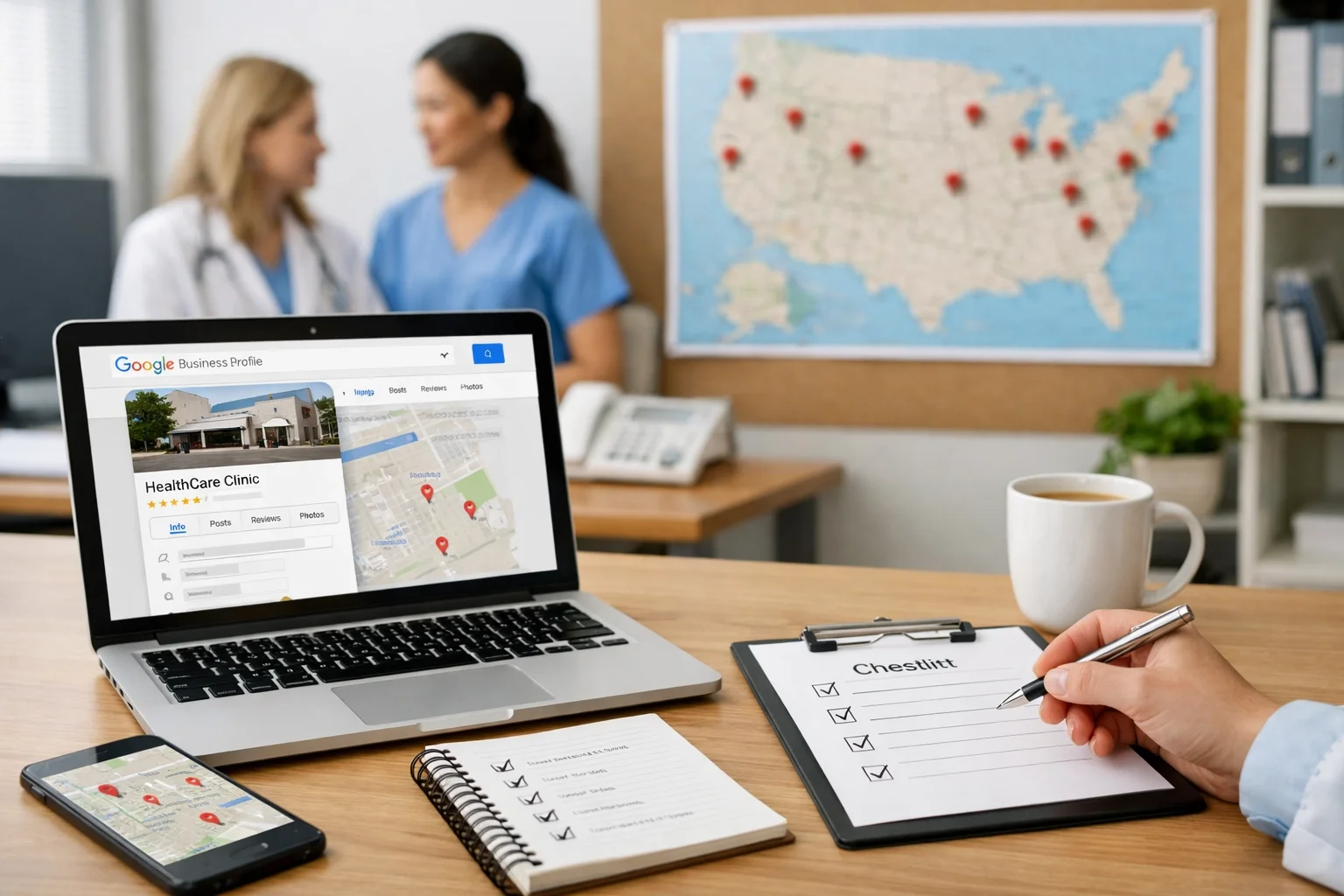
The multi-location checklist
The direct answer? You need a repeatable standard per location, plus just enough local customization to feel relevant.
Below is the checklist we use at Rex Marketing and CX when we’re optimizing a google business profile medical practice footprint across multiple clinics.
Are you using one profile per location?
The short answer? Yes, one verified profile per real, staffed location.
Do:
Create one GBP per physical location where patients can actually be seen.
Ensure each profile is verified and owned by the organization (not a former office manager’s Gmail).
Use a shared “brand-owned” Google account structure with role-based access.
Don’t:
Create duplicate profiles for the same address.
Create profiles for virtual-only locations unless Google explicitly allows it for your setup.
Mix practitioners and clinic locations in a way that confuses the patient journey.
Authority reference: Google’s own guidelines are the north star here, review the basics in Google Business Profile guidelines.
Founder takeaway: duplicates and ownership chaos are silent growth killers. Fixing them later is harder than doing it right now.
Is your NAP consistent everywhere?
The direct answer? Your Name, Address, Phone (NAP) has to match across GBP, your website, and your top directories.
For multi-location clinics, NAP problems usually come from:
Slight differences in suite formatting (Ste. vs Suite)
Call tracking numbers used inconsistently
Different “brand name” variants per office
Checklist:
Clinic name format is consistent (e.g., “Rex Family Clinic – West Loop” vs 12 variations).
Address is exact (same punctuation, suite style, and ZIP).
Phone number is location-specific where possible (and consistent across platforms).
Hours match your website location page.
Holiday hours updated proactively.
To validate citation consistency, scan your top profiles: Google, Apple, Bing, Yelp, Healthgrades, Zocdoc, major insurers, and local chamber listings.
Did you choose the right primary category?
The short answer? Your primary category is one of the biggest ranking levers you control.
Best practice:
Pick the most specific primary category that represents your core revenue service for that location.
Use secondary categories to expand relevance, but don’t turn your profile into a junk drawer.
Examples (conceptual):
Primary: “Urgent care center” (if that’s the core)
Secondary: “Medical clinic,” “Walk-in clinic” (if applicable)
Multi-location nuance: categories can differ by location if services differ. Don’t force a one-size-fits-all category set if one clinic is urgent care and another is primary care + pediatrics.
Authority reference: Google’s “categories” aren’t fully documented, but this overview helps: About business categories.
Does each location have a unique description?
The direct answer? Yes. Duplicate descriptions across locations waste an opportunity to be locally relevant.
Write like a human, optimize like a pro:
Two short paragraphs.
Mention the neighborhood/city naturally.
Call out key services patients search for (without keyword stuffing).
Explain “why trust us” (experience, approach, access, insurance, convenience).
What to avoid (especially in healthcare):
Claims you can’t prove (“best,” “#1,” “guaranteed results”)
Overly clinical language
Copy-pasting the same block across every clinic
Are your services built out?
The short answer? If your Services section is thin, you’re leaving rankings and conversions on the table.
Checklist:
Add core services patients search for (and that you want).
Use consistent naming conventions across locations (helps management and reporting).
Tie services to the right landing pages where possible.
Pro move for multi-location clinics: map each GBP service to a location page section (or a service + location page). This is where clinic SEO and GBP start reinforcing each other instead of competing.
If you’re building a privacy-first funnel (especially relevant for therapy and sensitive services), our approach is here: How to get more therapy clients using a privacy-first marketing strategy
Are your photos doing real work?
The direct answer? Photos are conversion assets, not decoration.
Google reports that photos can materially increase actions taken on listings. At scale, that becomes a measurable acquisition lever.
What each location should have (minimum set):
Exterior photos (daytime, clear signage)
Entrance + parking cues (patients care more than you think)
Reception/waiting area
Treatment rooms (no patients, no charts visible)
Equipment (where relevant)
A clean logo image
HIPAA caution: no patients, no whiteboards, no visible schedules, no “accidental PHI” in the background.
Are you using posts to reduce friction?
The short answer? GBP Posts work best as operational clarity + trust builders.
Post ideas that actually help patients:
“Now accepting new patients” (with appointment link)
“Same-day appointments available at [Location]”
Insurance updates (“Now in-network with…”)
Seasonal service reminders (sports physicals, flu shots)
New provider introductions (keep it credential-based, not hype)
Cadence suggestion for multi-location clinics:
1–2 posts per location per month is enough to stay fresh.
Centralize templates, then localize details (hours, parking, phone).
Are you answering Q&A?
The direct answer? You should seed the Q&A with the questions you already get at the front desk.
High-impact questions to add and answer (HIPAA-safe):
“Do I need an appointment?”
“Do you accept walk-ins?”
“What insurance do you take?”
“Where do I park?”
“How do I transfer records?”
“Do you offer telehealth?”
Authority reference: Google explains how Q&A works here: Ask and answer questions about a place.
Multi-location nuance: parking and access info should be location-specific. Don’t generalize.
Are you growing review volume?
The direct answer? Reviews are a ranking factor and a trust factor, but in healthcare, they’re also a compliance minefield.
The big rule: don’t confirm someone is a patient
Even if they say, “I was treated here,” you cannot respond in a way that confirms or references their care. The safest default is a generic, service-oriented response.
For HIPAA specifics, keep your leadership team grounded in primary sources:
Review request system (multi-location friendly)
Checklist:
Ask ethically at consistent points in the visit (checkout, follow-up, discharge).
Use a compliant SMS/email workflow that doesn’t disclose sensitive info.
Route unhappy patients to internal feedback first (without “review gating” in a misleading way).
Track review velocity by location.
HIPAA-safe response templates you can actually use
Positive review (generic, safe):
“Thanks for taking the time to share this. We appreciate the feedback and will share it with our team. If you’d like to follow up with our office directly, please call the number listed on our profile.”
Negative review (de-escalation, safe):
“We’re sorry to hear this and we’d like to learn more. To protect privacy, we can’t discuss details here. Please call our office number listed on this profile and ask for the clinic manager so we can address your concerns.”
If the reviewer shares medical details (still don’t engage):
“Thank you for your message. For your privacy, we recommend removing any personal health details from your review. If you need help, please contact our office directly so we can assist.”
What not to do:
“We saw you on Tuesday…”
“Our provider explained your diagnosis…”
“According to your chart…”
That’s the patient reviews HIPAA violation zone.
Are you measuring growth channel?
The direct answer? If you don’t track it, you can’t scale it.
What to track (by location, monthly)
Visibility
Searches (brand vs non-brand where available)
Map views vs Search views
Conversion actions
Calls
Website clicks
Direction requests
Appointment clicks (if integrated)
Reputation
New reviews count
Average rating
Response time and response rate
Operational signals
Top queries by location (tells you what patients think you are)
Photo views compared to competitors
Multi-location reporting that founders actually use
Set up a simple dashboard:
One page summary of all locations (traffic + actions + reviews)
A “bottom 3” list (locations needing help)
A “fast movers” list (what’s working and should be replicated)
This is where we often plug in as Rex Marketing and CX: we standardize the system, then run a monthly optimization loop so the profile footprint compounds over time.
The multi-location trap
The direct answer? Over-centralization makes every location feel generic: and patients don’t choose generic.
A practical balance:
Centralize: brand standards, compliance, templates, reporting, governance
Localize: photos, parking notes, neighborhood cues, provider availability, review responses (within guidelines)
Speed is easy to buy. Differentiation is not. GBP is one of the few places you can do both: fast.
30-day rollout plan
The direct answer? Don’t boil the ocean. Roll out in waves.
Week 1: Fix fundamentals
Ownership + access
Duplicate cleanup
NAP + hours audit
Week 2: Build relevance
Categories
Services
Descriptions
Q&A seeding
Week 3: Build trust
Photo refresh per location
Review request workflow
HIPAA-safe response templates live
Week 4: Build momentum
First post cadence
Reporting dashboard
Identify 2–3 locations to pilot deeper improvements
If you want a broader framework for tying local optimization to acquisition efficiency, this pairs well with: Stop wasting budget on healthcare advertising: 7 hacks to lower your CAC
How we help you win local search
The direct answer? We bring structure to chaos.
Most multi-location clinics don’t need more “marketing ideas.” They need:
a governance model for profiles,
a repeatable optimization checklist,
HIPAA-safe reputation workflows,
and reporting that ties local visibility to actual patient acquisition.
If you want us to review your profiles, identify quick wins, and map a scalable plan across all locations, you can book a free marketing consultation with the Rex Marketing and CX team.
