
Smarketing: How Startups Can Unite Marketing and Sales

Ready to grow your business?
Healthcare marketing professionals supporting startup founders often do everything “right” and still watch pipelines stall because marketing and sales friction keeps pulling the company in two directions. In early-stage company challenges, speed matters, yet lead handoff problems turn genuine interest into silence when context gets lost or follow-up feels disconnected. Team misalignment in startups shows up in the small daily moments, different definitions of a qualified lead, mismatched messaging, and competing priorities that erode trust fast in a regulated market. When marketing and sales move as separate teams, the best leads don’t just go cold; they slip away quietly.
Understanding Marketing and Sales Alignment
Marketing and sales alignment means both teams operate as one revenue system, not two separate functions. They share the same revenue goals, speak with one clear story, and collaborate so every lead gets consistent context. When that system is in place, trust rises because prospects hear the same promise from first click to first call.
It matters because healthcare buyers move carefully and expect continuity. Alignment creates faster follow-up, cleaner qualification, and fewer “start over” conversations that drain momentum. Teams that commit to aligned sales and marketing often see stronger growth because the handoff stops being a risk point.
Picture a founder pitching a compliance friendly solution. Marketing tees up the exact language, proof points, and objections, and sales continues that thread without detours. That continuity is how 38% higher win rates become realistic, not aspirational.
For healthcare growth teams, this workflow turns alignment into a weekly operating cadence, not a one-time kickoff. It protects lead momentum by making each sales funnel stage explicit, defining what “ready for sales” means, and ensuring every touchpoint carries the same context.
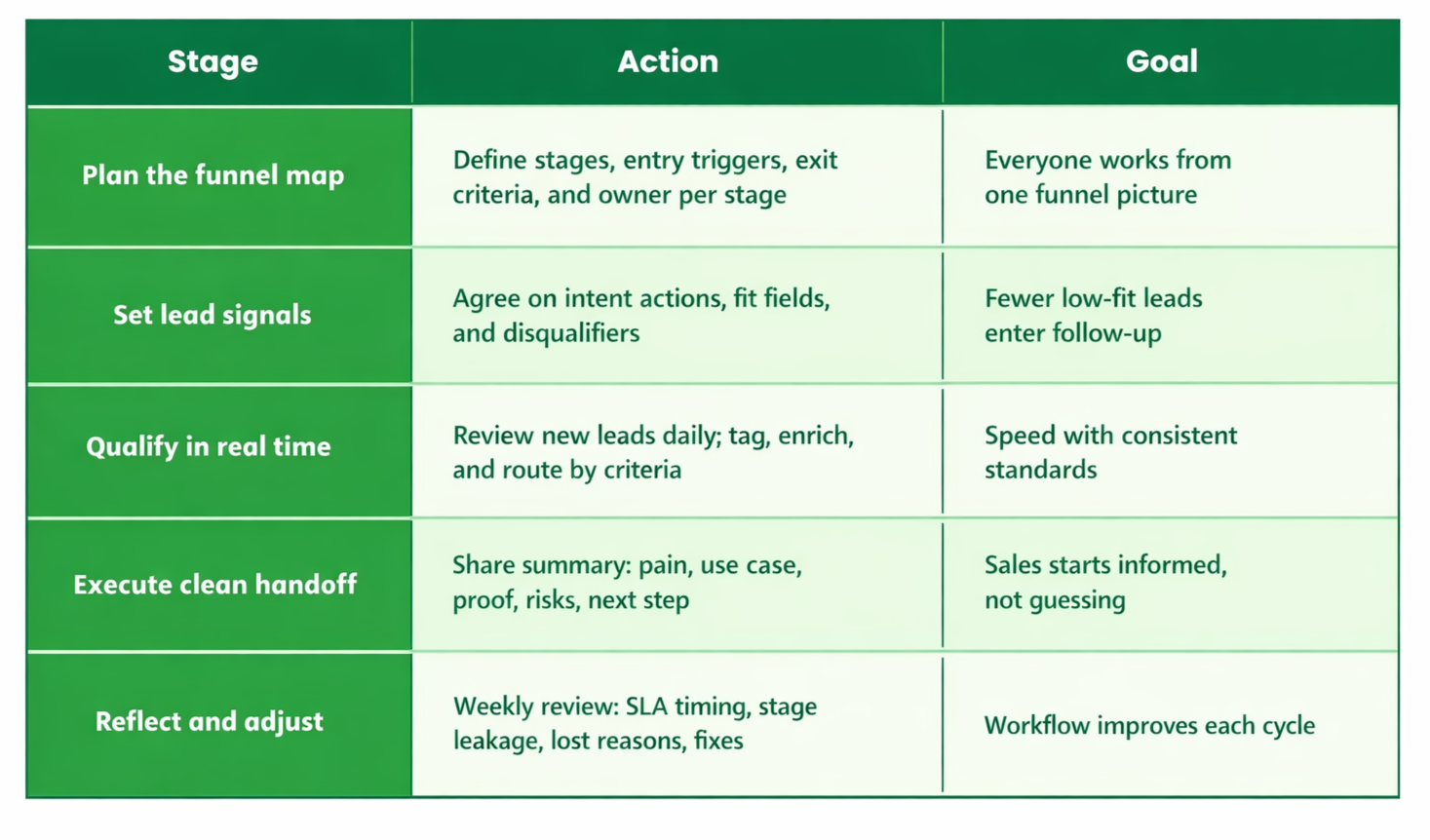
This rhythm creates a closed loop: planning sets expectations, signals guide triage, and qualification prevents drift before the handoff. The review step is where the system earns trust, especially when 67% of sales lost can be tied to poorly qualified leads.
Use 7 Low-Drama Tactics to Align Messaging, Goals, and Content
When marketing and sales share a workflow, the fastest wins come from small, repeatable habits, not big re-orgs. Use these tactics to reduce friction, protect focus, and keep leads moving through Plan → Signal → Qualify → Handoff → Improve.
Set one shared revenue target, and two supporting targets: Pick a single pipeline or revenue number both teams own (example: “$1.2M qualified pipeline this quarter”), then add two supporting targets like MQL-to-SQL rate and Sales Accepted Lead response time. This works because it stops the “my metric vs. your metric” debate and anchors decisions in outcomes. Review targets weekly for 15 minutes and adjust only if the lead definitions change.
Write a one-page lead lifecycle contract: In one doc, define what “Signal,” “Qualified,” and “Handoff” mean in your environment, especially for healthcare where intent can be subtle (job title, facility type, service line, compliance needs). Add clear thresholds such as “SQL requires role + need + timeline OR a demo request,” plus what happens when a lead is not ready. This reduces blame because everyone can point to the same rules when leads bounce back.
Create a unified sales messaging “spine” for every campaign: Agree on 3 core pain points, 3 proof points, and 3 approved claims marketing can use and sales can repeat verbatim. Add two short talk tracks: one for first-touch outreach and one for post-demo follow-up, tied to the same landing page language. The why: consistent language prevents leads from feeling like they entered a different company at handoff.
Run collaborative content planning around objections, not topics: Once a month, hold a 45-minute “Objection to Asset” session: sales brings the top 5 objections heard in discovery, marketing maps each objection to one asset for Signal and one for Qualify (e.g., a compliance FAQ page + a decision checklist). Assign an owner, due date, and where it will be used (email step, call follow-up, retargeting). This turns content into a pipeline tool, not a creative backlog.
Install a friction-reduction habit: the 24-hour handoff loop: For every lead handoff, require two fields from marketing (why it’s qualified + what content they consumed) and one field from sales within 24 hours (accepted/rejected + reason). If a lead is rejected, sales chooses from a short list of reasons that map to Improve actions, like “wrong facility type” or “missing timeline.” This keeps feedback structured and fast without extra meetings.
Standardize “two-lane” follow-up so no lead gets orphaned: Define Lane A for sales-ready (personal outreach within 1 business day) and Lane B for nurture (marketing sequence + periodic sales check-ins). Lane B isn’t “dead”, it’s Plan and Improve in action, where you build intent until the lead signals readiness. This lowers tension because both teams know exactly who is responsible at each moment.
Make teamwork visible with one shared scoreboard and one shared channel: Use a single weekly dashboard showing the same lifecycle stages you defined, Signal → Qualify → Handoff → Improve, so performance conversations stay grounded in process. Pair it with a lightweight communication space for quick clarifications; the growth of the unified communication as a service market signals how much modern teams value low-friction coordination. When the scoreboard is shared, credit becomes less important than momentum.
Common Questions on Marketing and Sales Alignment
Q: What are the main causes of friction between marketing and sales teams in early-stage startups, and how can they be addressed?
A: Friction usually comes from unclear definitions, mismatched incentives, and inconsistent follow-up that makes each team feel exposed. Address it by choosing a small set of shared outcomes, then writing simple lead stage rules everyone can point to. When expectations are explicit, “bad leads” becomes a fixable process issue, not a personal critique.
Q: How can startups create effective workflows that ensure smooth lead handoffs without prospects falling through the cracks?
A: Keep it lightweight: one owner per stage, one required response time, and one accepted way to reroute leads that are not ready. A two-path system helps: fast-track sales-ready inquiries and nurture the rest with scheduled check-ins. This matters because the average website conversion rate is often low in healthcare, so every qualified contact deserves a clean next step.
Q: What practical strategies can marketing and sales use to align their goals and messaging for better collaboration?
A: Start with a shared revenue or pipeline target, then add two supporting metrics like speed-to-first-touch and MQL-to-SQL rate. Next, agree on a short “message spine” sales can repeat and marketing can reuse across pages, emails, and outreach. Consistency reduces prospect anxiety and boosts confidence for both teams.
Q: Can you provide examples of how a clean handoff between marketing and sales improves conversion rates compared to a messy one?
A: Clean: the rep receives why the lead is a fit, what content was consumed, and the specific trigger, so outreach is timely and relevant. Messy: the lead arrives with no context, gets a generic pitch days later, and silently disengages. In healthcare, where long-term value is real, 85% of patients becoming recurring patients makes better conversion discipline worth the effort.
Q: How can someone feeling overwhelmed by managing overlapping responsibilities in a startup gain the structure and clarity needed to streamline collaboration between teams?
A: Shrink the problem: define three lead stages, pick two shared metrics, and schedule one short weekly review focused on decisions, not updates. Use a simple checklist for what must be captured at handoff and what feedback must be returned, so your brain stops carrying the system. If you want durability, add a structured leadership learning path, take a look at this for a structured curriculum, and build the habit of documenting, delegating, and coaching through change.
Choose One Alignment Move to Accelerate Healthcare Revenue Growth
When marketing and sales operate in parallel, leads slip through the cracks and momentum turns into meetings, delays, and doubt. The shift is choosing to run as an integrated revenue engine, one shared definition of progress, one lead lifecycle, and one rhythm of communication that both teams protect. Applied consistently, the marketing-sales partnership benefits show up fast: growth marketing success becomes repeatable, trust rises, and shortened sales cycles stop being a lucky break. Alignment isn’t a meeting; it’s a shared operating system for revenue. Choose one change to implement this week, pick a shared metric, finalize a lifecycle rule, or set the weekly sync, and let founder empowerment translate into healthier customer relationships and steadier growth.
If you’re looking for support aligning your sales and marketing as a healthcare business, reach out to the Rex Marketing & CX team today and learn how we can help.
