Why SEO is Even More Relevant with the Introduction of AI

Ready to grow your business?
Marketers are not imagining the shift. AI is reshaping how search results appear and how people engage with them. More questions are being answered directly in the results through summaries, conversational responses, and “best answer” experiences. It is natural to wonder: if AI can deliver the answer instantly, does SEO still matter?
Yes, SEO is still relevant because AI search still runs on the same foundation SEO strengthens: crawlable websites, credible information, clear relevance signals, and strong topical authority. AI can change the presentation, but it cannot produce reliable answers without reliable sources. The brands that publish content that is well-structured, specific, and verifiably useful are the ones most likely to be surfaced and referenced.
For marketers, the real shift is this: success is no longer only about ranking pages. It is about earning visibility within the answer layer while still capturing high-intent clicks when users need detail, proof, or a clear next step.
What AI Search Changes for SEO
AI affects two things at once: attention and attribution.
First, attention. When an AI summary appears, the search experience becomes more like a feed of synthesized answers than a list of ten links. That can compress the user journey. People often decide faster, and in some cases they stop at the summary.
Second, attribution. Even when AI helps a user make a decision, that influence may not show up as a clean organic click in your analytics. This is why some teams feel like organic is “declining” when brand demand and lead quality may actually be improving in parallel.
This does not mean SEO is dead. It means SEO is no longer only about clicks. It is also about being the brand that shapes the answer.
What is Answer Engine Optimization (AEO) and Generative Engine Optimization (GEO)?
Answer Engine Optimization (AEO)
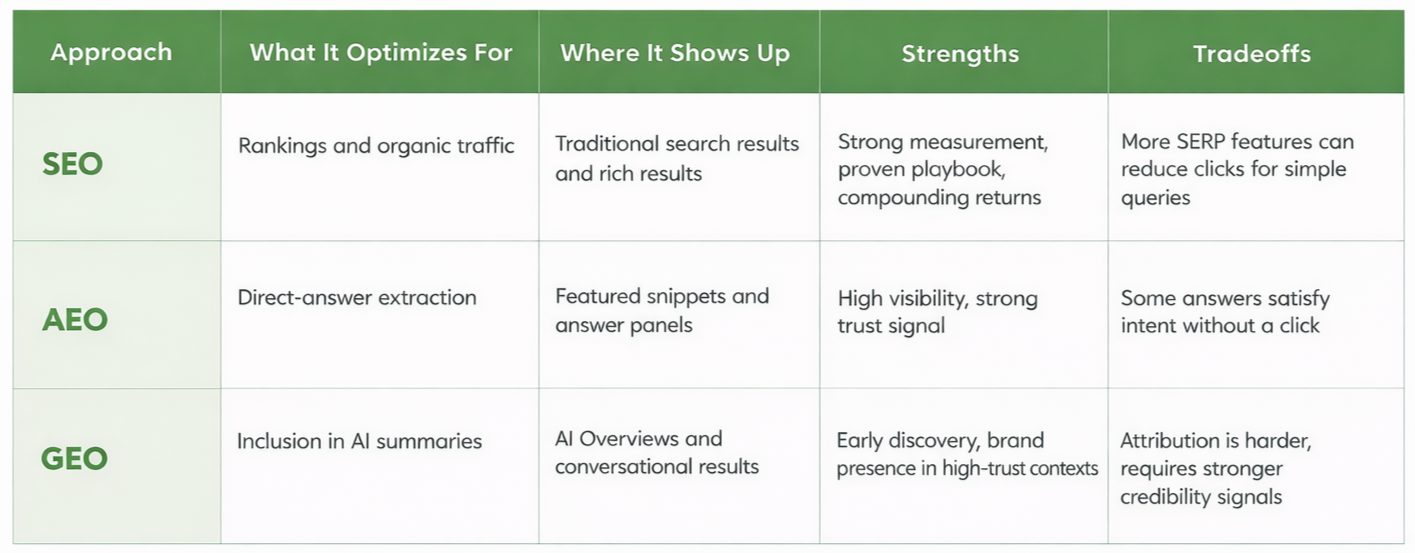
AEO focuses on making your content easy for search engines to extract into direct answers. Think of featured snippets, quick answers, and summary-style results. The goal is clarity and structure: you want your page to be the best candidate for the “answer slot.”
Generative Engine Optimization (GEO)
GEO takes that idea further into AI-generated results, where the system summarizes multiple sources and may cite a handful of brands. Here, the goal is not only ranking. It is being referenced, cited, and accurately described when the system composes an answer.
If SEO is “being found,” AEO is “being chosen as the answer,” and GEO is “being included in the synthesized explanation.”
Comparing SEO vs AEO vs GEO
Will AI Replace SEO?
No, AI will not replace SEO, but AI is most likely to reduce clicks for queries where the user wants a fast, self-contained response. Definitions, basic comparisons, simple checklists, and quick “how-to” instructions are increasingly answerable without leaving the search results.
But marketers should pay attention to the other category: queries that demand judgment, proof, or nuance. In healthcare, mental health, and wellness especially, users often want more than a generic answer. They want context, caveats, evidence, and a credible provider or brand behind the guidance. That is where high-quality SEO continues to drive meaningful outcomes, even if the “first touch” happens inside an AI summary.
A practical way to think about it is this: AI compresses the top of the funnel, but it does not remove the need for trusted destinations.
How to Build SEO Content AI Can Cite
The teams that struggle in the AI era usually fall into one of two traps. They either publish thin, reworded content at scale, or they cling to old keyword habits and ignore how answers are being presented.
A better approach is to make your pages “answer-first” while still being unmistakably original.
Start with the first screen. Your opening should resolve the question quickly, then immediately signal what makes your perspective better than the average summary. For example, instead of repeating a definition of SEO, explain what AI changes in buyer behavior, how it affects visibility, and what a marketer should do differently. That is the kind of detail an AI summary often cannot fully capture, and it encourages the click when the reader needs depth.
Then, build credibility signals into the page - clear claims, careful language, concrete examples, and content that shows you understand constraints. For regulated categories, “safe and accurate” is a competitive advantage, not a limitation.
Finally, design content so it can be extracted cleanly. That means direct headings, tight topic focus, and sections that answer real questions in a logical order. You can still write like a human. You just need to make it easier for systems to interpret your intent.
Search Metrics
If your SEO reporting still revolves around rankings and organic sessions, AI can make performance look worse than it actually is. The reason is simple: AI summaries can absorb some clicks, even when your content is influencing the decision. So the measurement shift is not “stop tracking traffic.” It is “track influence and demand capture alongside traffic.”
Here are the metrics that help marketers explain SEO performance in an AI-first SERP.
Track AI visibility, not just clicks
Rankings still matter, but visibility now includes whether your brand shows up in AI-driven answers.
A practical way to measure this is to define a set of high-value queries and check them regularly. Include informational queries where AI summaries often appear, along with commercial queries where the click still matters. If you see your pages referenced, summarized, or consistently positioned near the top, that is real visibility, even if CTR is lower than it was two years ago.
Monitor click quality, not only click volume
When fewer people click, the people who do click are often deeper in the decision process. That changes what “good” looks like.
Look at organic traffic segmented by:
Conversion rate and lead quality by landing page type (educational vs commercial)
Time to conversion for organic-assisted users
Sales outcomes: lead-to-close rate and average deal value for organic-influenced leads
If lead quality and close rate are improving, the channel is working, even if sessions are down.
Add branded demand signals to your dashboard
AI exposure often shows up as branded demand later. Users see your brand in an answer, then search you directly when they are ready.
Use:
Branded search impressions and clicks in Google Search Console
Growth in “brand + category” queries (example: “Rex Marketing healthcare SEO” style patterns)
Direct and organic returning visitors over time
These trends help you show that SEO is building memory and preference, not just visits.
Measure assisted conversions more seriously
In many funnels, SEO influences early, while paid, email, or direct closes the loop. AI makes that even more common.
Use GA4 attribution views to track:
Assisted conversions from organic
Organic’s share of first-touch sessions for converting users
Path length changes (do users convert in fewer steps now?)
This reframes SEO as a revenue contributor even when last-click credit moves elsewhere.
Watch CTR shifts by query type, then adjust content strategy
Instead of treating CTR drops as a blanket problem, segment them.
You will often find that:
“What is” queries lose CTR fastest when AI summaries appear
“Best,” “alternatives,” “cost,” and “near me” queries still drive clicks
High-stakes topics favor trusted brands, especially when content is precise and well-supported
This segmentation tells you where to invest in deeper content and where to optimize for being cited.
Best AI Tools for SEO
Most marketers do not need an AI tool for SEO. They need a tool that removes friction from one part of the workflow without degrading quality.
AI is most valuable in three places: speeding up research synthesis, improving content briefs, and supporting on-page optimization. It is least valuable when it is used to generate final drafts without a strong editorial standard, because the output converges toward the same safe phrasing your competitors are also publishing.
When evaluating best AI tools for SEO, judge tools by whether they help you produce content that is more specific and more trustworthy, not merely faster. Speed is easy to buy. Differentiation is not.
If you market in healthcare, mental health, or wellness, add one more filter: can your workflow support expert review, source verification, and careful language? In sensitive categories, generic content is not just ineffective. It can create real risk.
What to Track Now That AI Is in the SERP
If you only track rankings and organic sessions, you may miss the real impact of AI-era visibility. Consider adding measurements that reflect brand influence and demand capture: branded search trends, lead quality from organic, conversions assisted by organic entry points, and visibility for question-based queries that often trigger summaries.
You are trying to measure a broader outcome: whether your brand is becoming the trusted source in your category.
Conclusion
One important piece of advice: optimize to be the source, not the summary. AI makes it easier than ever to publish average content, which means the bar for being referenced, trusted, and clicked is rising. Marketers who invest in genuine topical authority, clean structure, and defensible claims will keep winning discovery, even as the interface changes.
If you want a practical plan to modernize your SEO, Rex Marketing & CX can help you build an approach that fits the realities of healthcare, mental health, and wellness marketing.
