
Why Your Google Business Profile Isn’t Bringing in New Patients
Ready to grow your business?
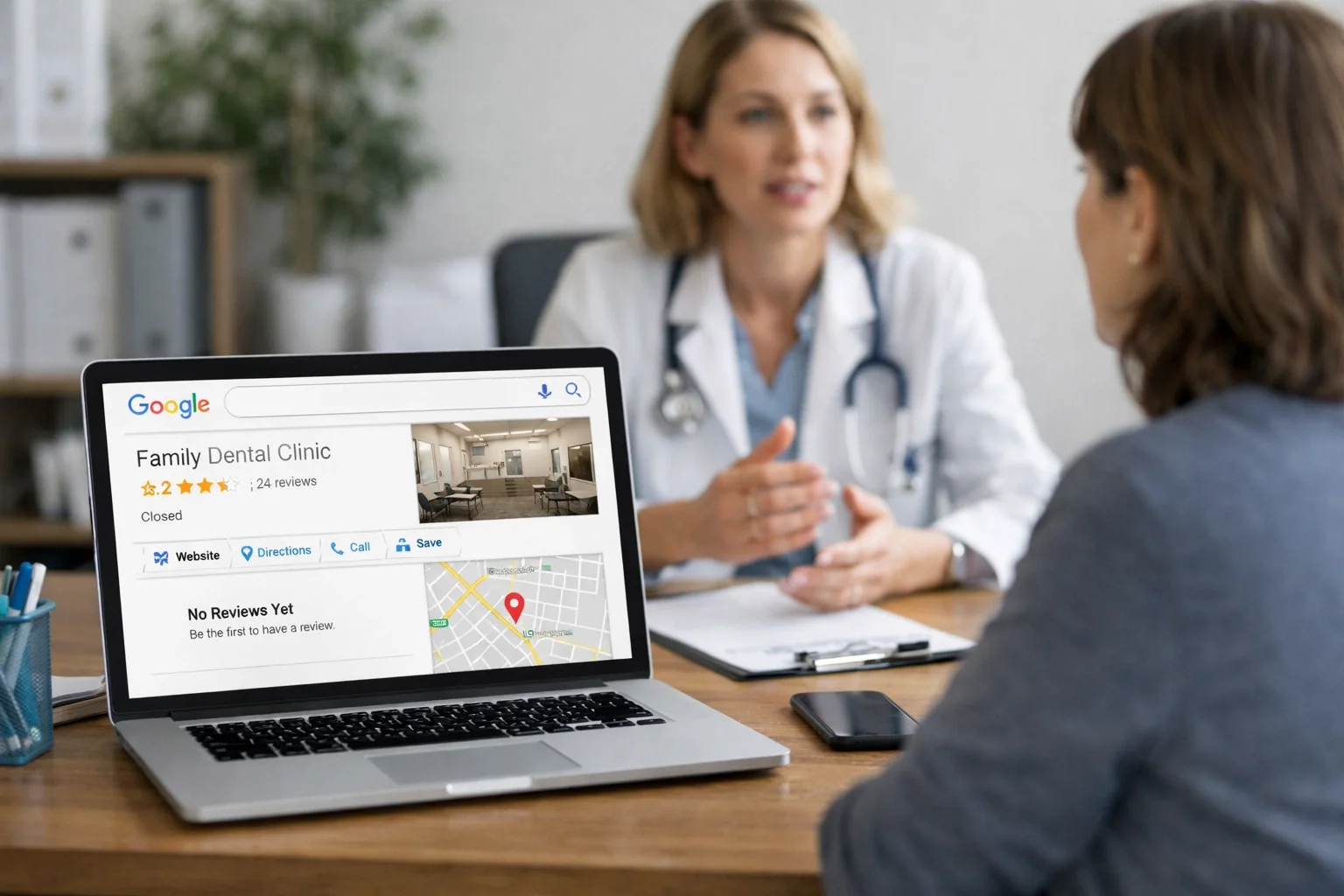
In the current healthcare landscape, your Google Business Profile (GBP) is often the first, and sometimes the only, interaction a potential patient has with your clinic before deciding to book an appointment. It functions as a digital front door. However, many practitioners find themselves frustrated when, despite having an active profile, the phone isn't ringing and the "Book Online" clicks remain stagnant. The short answer for why this happens? Most profiles are treated as static digital yellow page listings rather than dynamic conversion assets.
Optimizing a profile for a healthcare clinic in 2026 requires more than just a correct phone number. Google’s algorithms have become increasingly sophisticated at measuring local relevance, user intent, and trust signals. If your profile is languishing on the second page of local results, or if patients are seeing it but choosing your competitor down the street, it is likely due to one of several strategic oversights. We see these common pitfalls across dental practices, therapy clinics, and specialized medical groups alike.
1. The Verification and Ownership Gap
Is your profile actually verified and fully under your control? The short answer is often "no" or "partially." It is surprisingly common for healthcare founders to have a profile that was auto-generated by Google or created by a former employee using a personal email address. Without full verification, you lack access to critical features like direct messaging, review responses, and advanced analytics. More importantly, unverified or "claimed but not optimized" profiles are viewed by Google as less authoritative.
Google uses verification to ensure that the business actually exists at the physical location provided. In healthcare, where trust is the primary currency, an unverified status is a red flag for both the search engine and the patient. To resolve this, ensure your profile is verified through the official Google Business Profile support channels. Once verified, you gain the ability to manage your data and signal to the algorithm that your clinic is a legitimate, active entity in the local community.
2. Misaligned Primary and Secondary Categories
Does your primary category accurately reflect your most profitable service? Many clinics select a broad category like "Medical Clinic" and leave it at that. While accurate, it is often too generic to rank for high-intent searches. For example, if you are a mental health professional, choosing "Psychotherapist" as your primary category is significantly more effective than "Mental Health Service" if that is what your local patients are searching for.
Google allows for one primary category and up to nine secondary categories. The primary category carries the most weight for ranking. We often find that clinics have their categories set to something that doesn't match their actual patient acquisition goals. If you are struggling to rank, audit your competitors using tools or manual searches to see which categories they have prioritized. For a deeper dive into how this fits into your broader strategy, look at our ultimate guide to local SEO for doctors.
3. Inconsistent NAP Data Across the Web
Is your practice information identical across every directory? NAP stands for Name, Address, and Phone number. For Google to trust your location, it needs to see a "consensus" across the internet. If your GBP says "Suite 200" but your Yelp listing says "Ste 2" and your website says "Room 200," Google’s algorithm experiences a "trust gap." This inconsistency suggests the business might not be managed well, which can suppress your rankings in the local map pack.
Consistency is particularly difficult for multi-location clinics or practitioners who have recently moved offices. You must ensure that your data on your website, your GBP, and healthcare-specific directories like Healthgrades or ZocDoc are perfectly synced. This foundation of data integrity is the bedrock of medical practice SEO.
4. The Review Response Vacuum
Are you ignoring your patients’ feedback? The short answer is that engagement matters as much as the rating itself. Many practices believe that a 4.8-star rating is enough. However, Google’s local algorithm favors profiles that demonstrate active engagement. When you respond to a review, whether positive or negative, you are signaling that your clinic is operational and attentive to patient needs.
Furthermore, prospective patients read your responses to gauge your "bedside manner" before they ever meet you. A clinical, automated response to a heartfelt review feels cold. Conversely, a thoughtful, HIPAA-compliant response builds immediate rapport. We have discussed the nuances of using social proof the HIPAA-compliant way to help practices navigate these ethical waters without compromising patient privacy.
5. Lack of Natural, High-Quality Visual Content
Are you still using generic stock photos of smiling models in lab coats? Patients in 2026 are savvy; they can spot a stock photo from a mile away. If your profile is filled with "cheesy" imagery, you are failing to build a visual connection. People want to see the environment where they will be treated. They want to see the lobby, the exam rooms, and the friendly faces of the actual staff.
High-quality, natural photography of your actual space reduces the "anxiety of the unknown" for new patients. Profiles with actual photos of the business receive significantly more requests for directions and website clicks than those without. Avoid filters and over-editing; a clean, realistic representation of your clinic is far more effective at converting a lead than a polished but fake-looking marketing asset.
6. An Underutilized Services Menu
Did you know your "Services" section acts as hidden SEO keywords? Many healthcare providers leave the services section of their GBP blank or use only the default options. This is a missed opportunity. Google uses the text within your services descriptions to match your profile with specific user queries. If a patient searches for "trauma-informed therapy near me," and you have that specific service detailed in your menu, you are much more likely to appear.
Each service should have a clear title and a descriptive paragraph explaining what it is and who it is for. This is where you can use "high-intent" terminology that patients actually use, rather than just medical jargon. By treating your services menu as a mini-landing page, you give Google more "meat" to crawl and index for local search.
7. Ghost-Town Google Posts
Are you posting updates to your profile at least once a week? Google Posts are essentially "social media" for your business profile. They appear directly in search results and can be used to highlight new providers, seasonal health tips, or community events. While they might not be a direct ranking factor in the traditional sense, they drastically improve click-through rates.
A profile with regular posts looks "alive." If a patient sees a post from two days ago about a new flu vaccine clinic and your competitor's last update was from 2022, you win the trust battle. These posts also provide an opportunity to drive traffic to specific pages on your site, such as a blog post on healthcare content strategy.
8. Negative Review Friction and HIPAA Fears
Does a single one-star review paralyze your marketing efforts? Many doctors are afraid to solicit reviews because they fear one disgruntled patient will ruin their reputation or that responding will violate HIPAA. The truth is that a perfect 5.0 rating can sometimes look suspicious. A few 4-star or even 3-star reviews can make a profile look more authentic, provided they are handled correctly.
The key to handling negative reviews is a standard operating procedure that emphasizes privacy. You should never confirm that the reviewer is a patient. A simple, "We take all feedback seriously; please contact our office manager at [Phone Number] so we can discuss this further," is often all that is needed. It shows other readers that you are professional and responsive without breaching confidentiality.
9. Poor Attribution and Tracking
How do you know if your GBP is actually working? If you aren't using UTM parameters on your website link, all of your GBP traffic likely shows up as "Direct" or "Organic" in your Google Analytics. This makes it impossible to see the ROI of your optimization efforts. By adding a simple tracking code to your URL, you can see exactly how many appointments were booked specifically from people who found you on the map.
Without tracking, you are flying blind. You might think your profile isn't working when, in reality, it's your primary source of new leads. Understanding the data allows you to double down on what works. If you are struggling with the technical side of this, our guide on adding Google Analytics to your platform can provide clarity on how to structure your tracking.
10. The Multi-Location Conflict
Are your multiple locations competing with each other? For clinics with several offices in a single city, Google may "filter" out some of your locations if they are too close together or if the information is too similar. This is known as self-cannibalization in local SEO. Each location needs its own distinct profile, unique photos, and a localized landing page on your website.
Managing several profiles requires a coordinated strategy to ensure that each location ranks for its specific neighborhood. If you are operating a group practice, you should read our specific breakdown on optimizing GBP for multi-location clinics to avoid these common ranking filters.
What to Track for Success
To move the needle, you need to look beyond the "Views" metric in your GBP dashboard. Views are a "vanity metric" that doesn't necessarily correlate with revenue. Instead, focus on these three key performance indicators:
Direct Interactions: This includes phone calls initiated from the profile and "Request for Directions" clicks. These are high-intent actions.
Website Click-Through Rate (CTR): How many people see your profile and feel compelled to learn more on your site?
Review Velocity: The rate at which you are receiving new, high-quality reviews compared to your local competitors.
If these metrics are trending upward, your optimization is working. If they are flat, it’s time to revisit your categories, photos, or posting frequency.
Moving Forward
A Google Business Profile is not a "set it and forget it" tool. It is a living extension of your clinic's brand. In an era where patient choice is driven by convenience and digital trust, your profile must work harder than ever to convert a searcher into a patient. By addressing these ten areas, you transition from being "just another option" to being the clear local leader in your field.
If you are feeling overwhelmed by the technical requirements or simply don't have the hours in the day to manage your local presence effectively, we can help. Our team specializes in bridging the gap between clinical excellence and digital visibility.
Ready to stop losing patients to the clinic down the street? You can book a free marketing consultation with Rex Marketing and CX today to audit your local SEO strategy and start growing your practice.
